|

|
|
| Books |
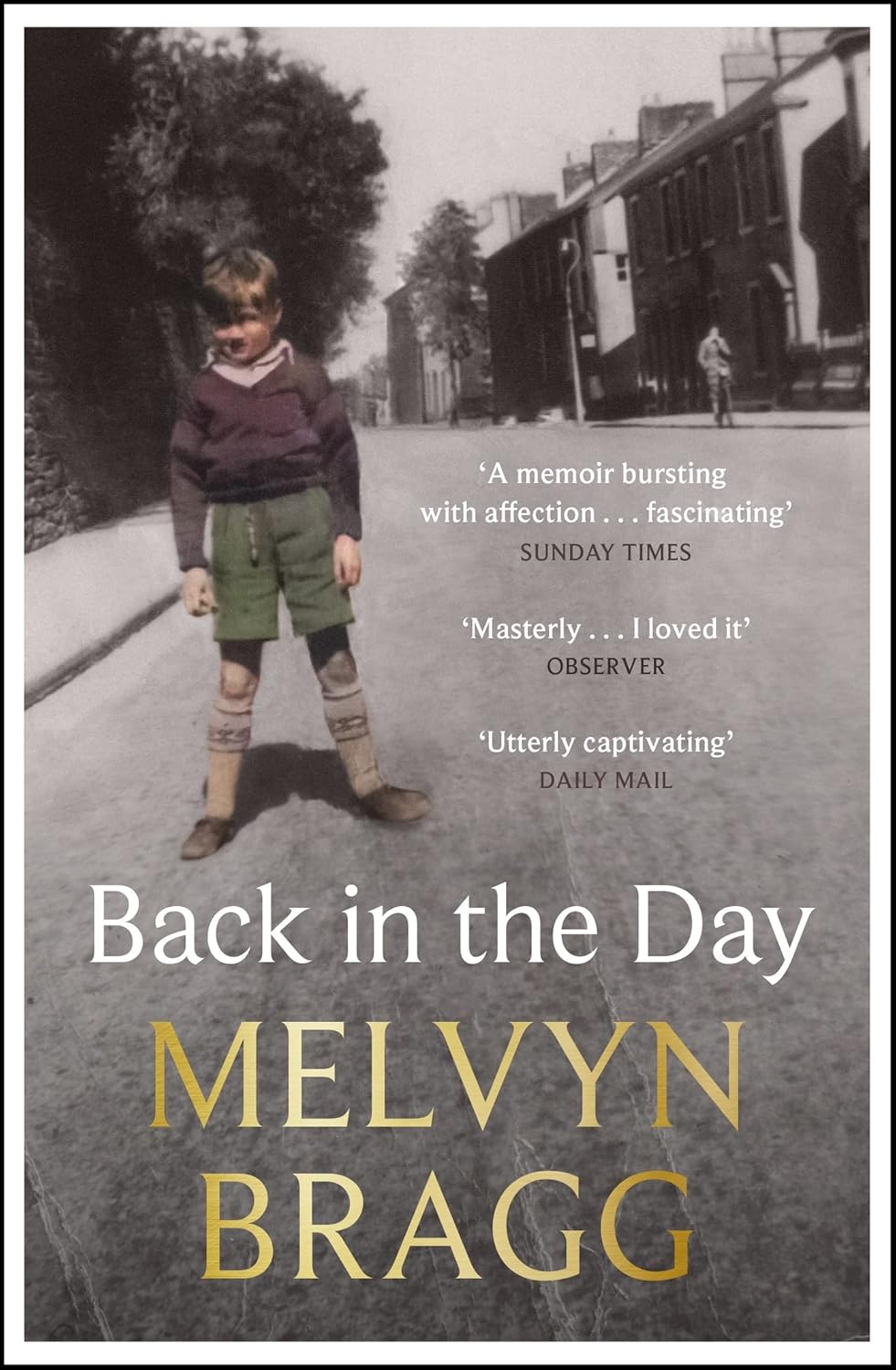
BACK
IN THE DAY
A Memoir
by
Melvyn Bragg
(2022) |
Melvyn
Bragg recalls his working-class roots growing up in the
Cumbrian town of Wigton and the breakdown as a teenager which
would lead him to leaving. |
|
| Cumbria |
 Cumbria
lies in north-western England on the Irish Sea and borders Scotland
to the north. It was formed in
1974 from the ancient counties of Cumberland
and Westmorland together with the Furness
area of neighbouring Lancashire. Cumbria
lies in north-western England on the Irish Sea and borders Scotland
to the north. It was formed in
1974 from the ancient counties of Cumberland
and Westmorland together with the Furness
area of neighbouring Lancashire.

Towns include Carlisle, the former county seat of Cumberland and Appleby,
the former county seat of Westmorland.
Scafell Pike, at 978 metres England's highest mountain, is found in
the county as is Lake Windermere, the country's largest lake.
After
centuries alternating between Scottish and English rule, the region
finally became part of England in 1157. |
| Areas of Outstanding
Natural Beauty | National Landscapes |
The Solway
Coast was designated in 1964 to protect the English coastline
of the Solway Firth, the UK's third largest estuary. The National
Landscape runs from Rockcliffe
Marsh on the Scottish border down to Maryport. The area has a
high ecological value for local wildlife and due to its location near
Scotland, has also many sites of historical and cultural importance.
The Arnside
and Silverdale National Landscape was designated in 1972 covering
an area running down to the shores of Morecambe Bay and divided between
the counties of Cumbria in the north and Lancashire in the south.
The landscape includes valleys and woodlands and limestone hills which
offer views out to the Kent
Estuary and east to the Lake District.
The North
Pennines National Landscape is the second largest in England and
Wales (after the Cotswolds) and was designated in 1988. The protected
area spreads over the three counties of Northumberland, Cumbria and
Durham and was once the location of intensive lead mining, the decline
of which has left its mark on the local landscape. The area marks
the northern end of the mountain range which runs down the centre
of the country to Derbyshire, "the backbone of Britain".

 |
| Composers
and Musicians |
The singer-songwriter Christine McVie
was born as Christine Anne Perfect in Greenodd (then in Lancashire)
in 1943. She joined Fleetwood
Mac
in 1970 after marrying John McVie (with Mick Fleetwood one of the
band's founding members).
After Lindsay Buckingham and Stevie Nicks joined in 1974 worldwide
success followed with Christine McVie writing many of their best-known
songs including Say You Love Me (1975), Don't Stop (1977),
Songbird
(1977), You Make Loving Fun (1977) and Everywhere
(1987).
 Fleetwood Mac
Fleetwood Mac:
Songbird
(McVie)
Fleetwood Mac:
Everywhere
(McVie)
|
| Famous
People |
In 1967 Donald
Campbell died on Coniston
Water in the Lake District whilst attempting
the world speed record on water in Bluebird.
It wasn't until 2001 that his body was recovered and buried at the
nearby cemetery.
Following in his father Malcolm's footsteps (who had also set land
and water speed records) Donald Campbell had set the water speed record
six times (four times at Coniston) and in Australia in 1964 achieved
something that has never been achieved by setting both the world land
and water speed records in one year.
 Donald
Campbell
Donald
Campbell
|
| Inventors
and Scientists |
Seen as the "father of atomic theory", the chemist John
Dalton was
born
in 1766 in Eaglesfield, Cumberland. His research led him to describe
colour blindness or "Daltonism" in 1794 and later to his
ground-breaking work in atomic theory.
John
Dalton
|
| Writers
and Poets |
|
William
Wordsworth
was born in 1770 at Cockermouth,
Cumberland. He lived from 1799-1808 at Dove
Cottage in the village of Grasmere. From 1808-13 he lived at
nearby Allan
Bank and from 1813 until his death in 1850 at Rydal
Mount, Ambleside. He was buried at Grasmere. He had succeeded
his friend Robert Southey as Poet
Laureate in 1843 and in 1850 was succeeded by Alfred
Tennyson. Wordsworth's friend and occasional collaborator Samuel
Taylor Coleridge lived nearby at Keswick, Cumberland.
William
Wordsworth
 The
Wordsworths
The
Wordsworths
 Poets
laureate
Poets
laureate
Wordsworth Trust

I wandered lonely as a cloud
That floats on high o'er vales and hills,
When all at once I saw a crowd,
A host, of golden daffodils;
Beside the lake, beneath the trees,
Fluttering and dancing in the breeze.
Wordsworth - I
wandered lonely as a cloud (1815)
I may not hope from outward forms to win
The passion and the life, whose fountains are within.
Coleridge - Dejection: an Ode (1802)
Wordsworth's
friend and Coleridge's brother-in-law, the fellow poet Robert
Southey, died in Keswick, Cumberland in 1843. He was
buried nearby at Crosthwaite. Southey had been
Poet
Laureate
since succeeding Henry James Pye in 1813 and was himself succeeded
by Wordsworth.
Inspired
by the scenery of the Lake District they were known as the "lake
poets".
Robert
Southey
Poets
laureate
Live as long as you may, the first twenty
years are the longest half of your life.
The Doctor (1812)
In
1943 the children's book author and illustrator Beatrix
Potter died at her farm Hill
Top
by the village of Near Sawrey where she had written many of her
books.
Beatrix
Potter
Beatrix
Potter Society
|

|
|