|
|
| Books |
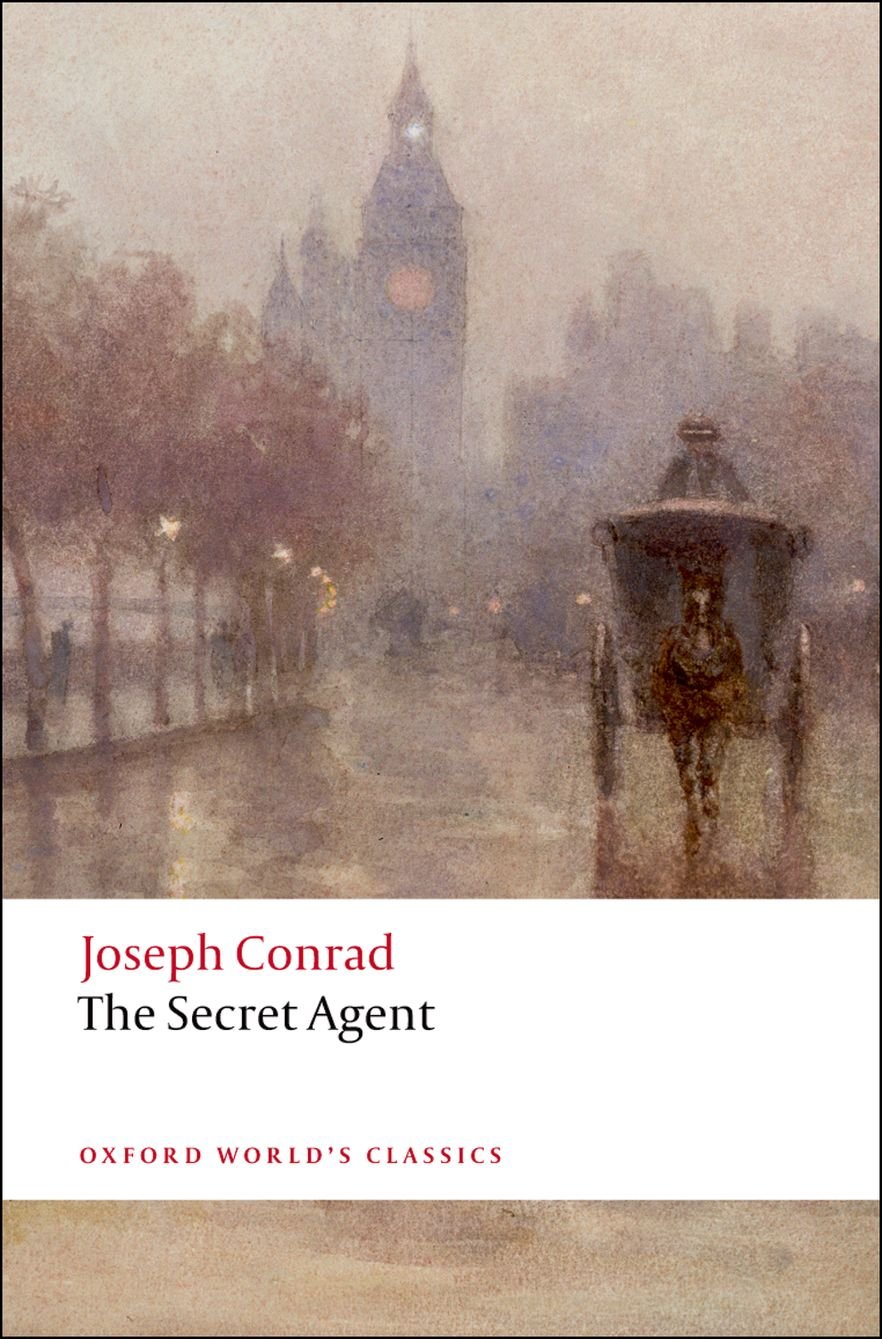
THE
SECRET AGENT
by
Joseph Conrad
(1907) |
After two decades at sea Joseph Conrad settled in England
in 1894 and began to write.
Despite English being his third language he would become one
of its greatest novelists.
One of his best was The Secret Agent, the only
story he set in London.
To discredit a mixed group of revolutionaries an agent of
a foreign embassy is planning a series of bomb attacks in
the capital. The first target: the Greenwich Observatory.
|
|
| London
| Greenwich |
 The
County of London was formed in 1889 from parts of the ancient counties
of Middlesex, Kent and Surrey, with
the City of London remaining an independent body.
The
County of London was formed in 1889 from parts of the ancient counties
of Middlesex, Kent and Surrey, with
the City of London remaining an independent body.
In 1965 Greater London was formed,
taking in the rest of Middlesex (which no longer existed as a county)
together with parts of Essex and Hertfordshire and further areas of
Kent and Surrey.

Greater
London is made up of 13 Inner and 19 Outer London boroughs together
with the City of London.
Greenwich once lay in Kent
and is today one of the 19 boroughs making up Outer London. It lies
on the eastern edge of the capital bordering the River Thames to its
north.
 London Boroughs
 |
| Anglo-Saxons
and Danes |
|
Anglo-Saxon Kings
Danish Kings |
The borough once lay in Kent
which was an independent kingdom, but
was later to become part of Wessex.
The kingdom of Kent reached north to the river Thames, across which
lay the kingdom of the East Saxons (Essex) and south and west to the
kingdom of the South Saxons (Sussex).

 |
|
Famous
People
|
|
The
suffragette Emily
Davison was born at Roxburgh House in Blackheath in 1872. She
resorted to militant actions for which she was often imprisoned.
In 1913 she died from injuries sustained when she was trampled after
trying to stop the king's horse at the Epsom Derby.
|
| Prime
Ministers |
|
Prime Ministers |
| 19th
Century |
Spencer
Perceval,
who became Prime Minister in 1809, was buried in 1812 at St
Luke's in Charlton. He was the only Prime Minister to be assassinated
when he was shot by a disgruntled businessman in the lobby of
the House of Commons.
 Spencer
Perceval
Spencer
Perceval
|
|
| World
Heritage Sites |
In
1997 Greenwich
Maritime was designated a World Heritage Site. The site includes
buildings designed by such architects as Sir Christopher Wren and
Inigo Jones.
|
| Writers
and Poets |
The
suspense writer Edgar Wallace was found
abandoned at the age of nine days in Greenwich in 1875. He was named
Richard Horatio Edgar Wallace.
The
spy writer Eric Ambler
was born as Eric Clifford Ambler in Charlton in 1909. His books had
a wide influence on future writers in the genre. Two early books were
later made into successful films: The Mask of Dimitrios (1939)
and Journey into Fear (1940). The Light of Day (1962)
is seen as his best and was made into the film Topkapi.
In
1972 Eric Ambler was awarded a Gold Dagger from the Crime Writers'
Association for The Levanter and in 1986 he was awarded the
Diamond Dagger for his lifetime contribution to crime writing.
Eric
Ambler (1962)
Eric
Ambler (1977)
The
writer Bernardine
Evaristo was born as Bernardine Anne
Mobolaji Evaristo in Woolwich in 1959, the daughter of a Nigerian
father and an English mother. Her novel Girl, Woman, Other (2019)
won the Booker
Prize
(the first Black woman to do so), co-winning the award with Margaret
Atwood for The Testaments.
Bernardine
Evaristo
 Bernardine
Evaristo Bernardine
Evaristo
|

|
|