|
|
| Books |
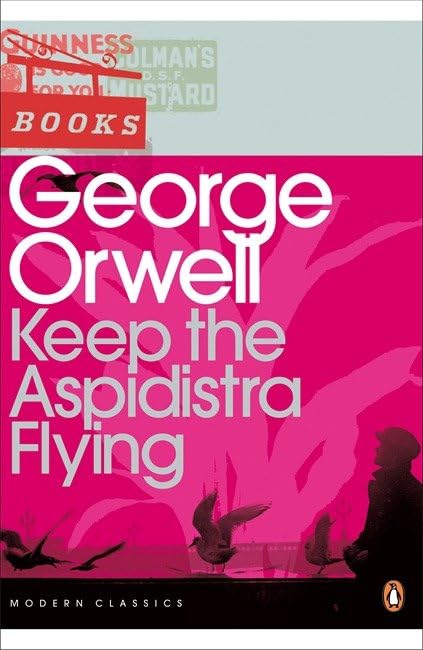
KEEP
THE
ASPIDISTRA FLYING
by
George Orwell
(1936) |
Set
in Hampstead in the 1930s where George Orwell lived in
similar circumstances to Gordon Comstock.
Comstock rebels against his middle-class background. He rejects
money, status and a materialistic lifestyle but finds that poverty
is also not the solution. |
|
| London
| Camden |
 The
County of London was formed in 1889 from parts of the ancient counties
of Middlesex, Kent and Surrey, with
the City of London remaining an independent body.
The
County of London was formed in 1889 from parts of the ancient counties
of Middlesex, Kent and Surrey, with
the City of London remaining an independent body.
In 1965 Greater London was formed,
taking in the rest of Middlesex (which no longer existed as a county)
together with parts of Essex and Hertfordshire and further areas of
Kent and Surrey.

Greater
London is made up of 13 Inner and 19 Outer London boroughs together
with the City of London.
Camden once lay in Middlesex and is today one of
the 13 boroughs making up Inner London. It borders the City of Westminster
to its south.
 London Boroughs
 |
| Actors
and Directors |
The film director John Schlesinger
was born as John Richard Schlesinger in Hampstead in 1926. His first
two British feature films were milestones: A Kind of Loving
(1962) and Billy Liar (1963), kitchen sink dramas showing the
reality of working-class life in the north of England.
In 1969 his first Hollywood film was his biggest success: Midnight
Cowboy won an Academy Award for Best Film and Schlesinger an Academy
Award for Best Director. In 1976 he had a further box-office success
with Marathon Man starring Dustin Hoffman and Laurence Olivier
and written by William Goldman.
 John
Schlesinger John
Schlesinger

 |
| Anglo-Saxons
and Danes |
|
Anglo-Saxon Kings
Danish Kings |
The
borough once lay in Middlesex which once formed the kingdom
of the Middle Saxons, so named because
their kingdom lay between those of the East Saxons (Essex) and the
West Saxons (Wessex).
|
| Composers
and Musicians |
The youngest son of Johann Sebastian Bach, Johann
Christian Bach was buried in 1782 in St
Pancras. He had been born in Leipzig in Germany in 1735 and had lived
in London since 1762.
Johann
Christian Bach
|
| Prime
Ministers |
|
Prime Ministers |
|
18th Century |
The Duke
of Newcastle, twice Prime
Minister in 1754-56 and 1757-62, died in 1768 in Lincoln's Inn
Fields. In 1754 he had succeeded his brother Henry Pelham as
Prime Minister.
Duke
of Newcastle
|
|
19th Century |
Prime Minister from 1801-04, Henry
Addington was born in Bedford Row in Holborn in 1757.
Henry
Addington
Benjamin
Disraeli was
born
in Bedford Row, Holburn in 1804. He would become twice Prime
Minister in 1868 and 1874-80.
Benjamin
Disraeli

Youth is a blunder; Manhood a struggle;
Old Age a regret.
Coningsby (1844)
You know who the critics are? The men
who have failed in literature and art.
Lothair (1870)
|
|
|
Writers
and Poets
|
|
For Doris Lessing see Nobel
Prize Winners
In
1797 the pioneering feminist and writer Mary
Wollstonecraft died at her home she shared with her husband
William Godwin in Somers Town shortly
after giving birth to her daughter. Her daughter was Mary
Shelley. Mary Wollstonecraft wrote A Vindication of the Rights
of Women.
Mary
Wollstonecraft
Mary
Shelley
 Mary
Wollstonecraft
Mary
Wollstonecraft
I do not wish them (women) to have power over men; but over themselves.
A Vindication of the Rights of Women (1792)
A slavish bondage to parents cramps every
faculty of the mind.
A Vindication of the Rights of Women (1792)
From 1818 until 1820 John Keats lived
at Wentworth
Place in Hampstead before leaving for Italy
to try and alleviate his tuberculosis.
John
Keats
 John Keats website
A thing of beauty is a joy for ever:
Its loveliness increases; it will never
Pass into nothingness; but still will keep
A bower quiet for us, and a sleep
Full of sweet dreams, and health, and quiet breathing.
Endymion
(1818)
And she forgot the stars, the moon, and
sun,
And she forgot the blue above the trees,
And she forgot the dells where waters run,
And she forgot the chilly autumn breeze;
Isabella (1820)
In
1834 Samuel
Taylor Coleridge
died at 3, The Grove in Highgate, his home for the last eighteen
years of his life. The house belonged to his doctor who was treating
him for opium addiction. Coleridge is buried at St Michael's Chruch
in Highgate.
Samuel
Taylor Coleridge
Friends of Coleridge
The Sun's rim dips; the stars rush out;
At one stride comes the dark.
The
Rime of the Ancient Mariner (1798)
In
1880 the author of Middlemarch George
Eliot was buried at Highgate
Cemetary.
George
Eliot
Famous
London cemeteries
The
poet Christina
Rossetti died at her home at 30 Torrington Square in 1894 and
she is buried at Highgate
Cemetary.
Christina
Rossetti
Famous
London cemeteries
Remember me when I am gone away,
Gone far away into the silent land.
Remember
(1862)
Better by far you should forget and smile
Than that you should remember and be sad.
Remember
(1862)
The
writer Stella Gibbons was born in
Kentish Town in 1902. She studied journalism in London and worked
for a decade at a series of newspapers in the capital (including
the London Evening Standard). Her first novel would prove
to be her best, the classic parody Cold Comfort Farm (1932).
After her parents' deaths Flora Poste goes to stay with her relatives
the Starkadders at their Sussex farm and decides to shake up their
lives.
In 1936 she moved to Oakshott Avenue in the Holly Lodge Estate in
Highgate and would spend the rest of her life there, dying there
in 1989. She was buried at Highgate
Cemetery.
Stella Gibbons (1940s)
Stella Gibbons (1988)
She liked Victorian novels.
They were the only kind of novel you could read while you were eating
an apple.
Cold Comfort Farm (1932)
Something nasty in the woodshed.
Cold Comfort Farm (1932)
The
writer Alan
Sillitoe
- author of Saturday Night and Sunday Morning and The
Loneliness of the Long Distance Runner - was buried in 2010
at Highgate
Cemetery.
Alan Sillitoe
If I had the whip hand... I'd get all the cops, governors, posh
whores, army officers, and members of Parliament and I'd stick 'em
up against this wall and let 'em have it.
The Loneliness of the Long Distance Runner (1959)
They think they've got me house-trained.
The Loneliness of the Long Distance Runner (1959)
The
novelist Beryl
Bainbridge was buried in 2010 in Highgate
Cemetery. After
an early career acting in the theatre she became a writer and six
of her books were shortlisted for the Booker
Prize.
Beryl
Bainbridge
|

|
|